


 Request an Appointment
Macular Degeneration Care
Fargo Macular
Degeneration Care
Eyes on 45th provides comprehensive macular degeneration monitoring and treatment, including the Valeda Red Light Therapy - the first FDA-authorized treatment for early and intermediate dry AMD. Dr. Tufte has examined over 855,000 eyes individually and monitors AMD closely with advanced imaging technology.
 Advanced Optomap & OCT imaging
- Valeda Red Light Therapy - only provider in the area
- Year-over-year retinal comparison monitoring
- Personalized care plan for every patient
Valeda Specialty Clinic
Valeda Red Light
Therapy Clinic
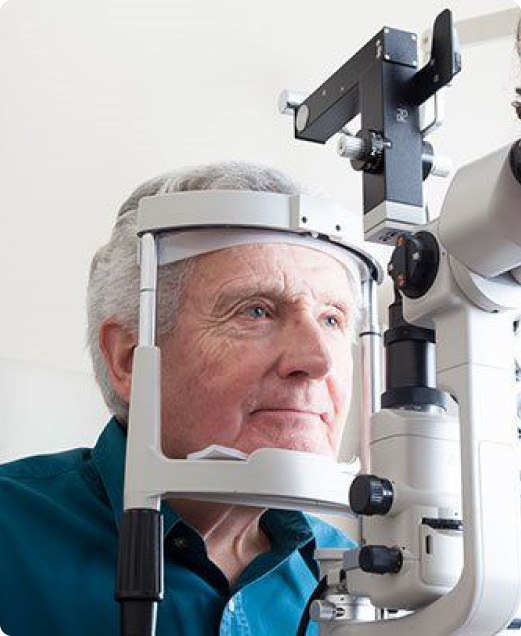
Eyes on 45th operates a dedicated Valeda specialty clinic within our practice, staffed by experienced optometrists who specialize in red light therapy for early and intermediate dry AMD. This clinic focuses exclusively on delivering Valeda treatment with precision and personalized follow-up care.
Our Valeda clinic is designed for patients with early and intermediate dry AMD. We use advanced imaging and clinical evaluation to confirm eligibility, then deliver the treatment in a controlled environment with ongoing monitoring to support long-term retinal health.
- FDA-authorized for early and intermediate dry AMD
- Non-invasive, painless treatment sessions
- Each session under 5 minutes per eye
- Only Valeda provider in the Fargo area
A Typical Valeda Course
Session Schedule
9 sessions over 3-5 weeks, with 3 sessions per week.
Session Duration
Under 5 minutes per eye. Remove glasses or contacts before each session.
Follow-Up Courses
Follow-up courses are generally recommended every 4 months for ongoing benefit.
Who Qualifies
Early or intermediate dry AMD with medium/large drusen or non-central geographic atrophy. Imaging confirms eligibility.
Understanding AMD
What Is Macular
Degeneration?
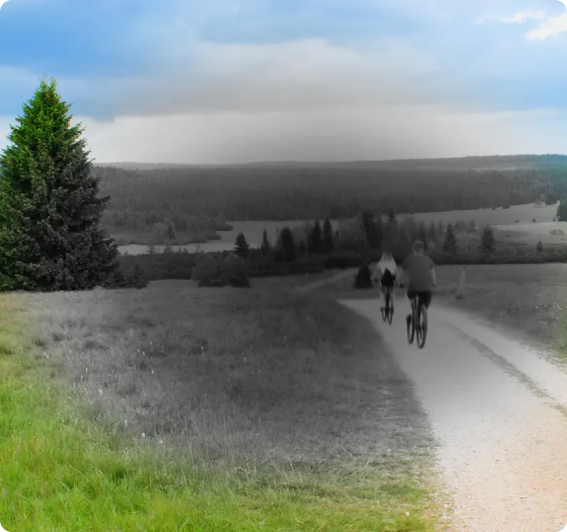
The macula is the small central part of your retina responsible for sharp, straight-ahead vision. Age-related macular degeneration (AMD) is one of the leading causes of vision loss in adults over 50. It doesn’t cause total blindness, but it can affect the central vision you use for reading, driving, and recognizing faces.
Early detection is critical. With advanced imaging, we can identify microscopic changes long before they affect your daily life - and act while treatment options are most effective.
Schedule a ScreeningSymptoms to Watch For
Signs of Macular Degeneration
Any of these changes warrant an eye exam soon. Early symptoms are often subtle -
don’t wait until vision loss is obvious.
Straight lines look wavy or bent
The Amsler grid test helps detect this early warning sign of AMD.
Blurred or dim patch in central vision
A growing blind spot in the center of your visual field is a key symptom.
Needing more light to read
Increased light sensitivity is common in AMD patients.
Colors appear less vivid
Color perception changes as the macula deteriorates.
Difficulty recognizing faces
Central vision loss makes facial recognition increasingly difficult.
Trouble reading fine print
Words may blur or disappear when reading, even with glasses.
Two Types of AMD
Dry AMD vs.
Wet AMD
AMD comes in two distinct forms with very different progression patterns. Understanding which type you have determines everything about how it’s managed.
Dry AMD
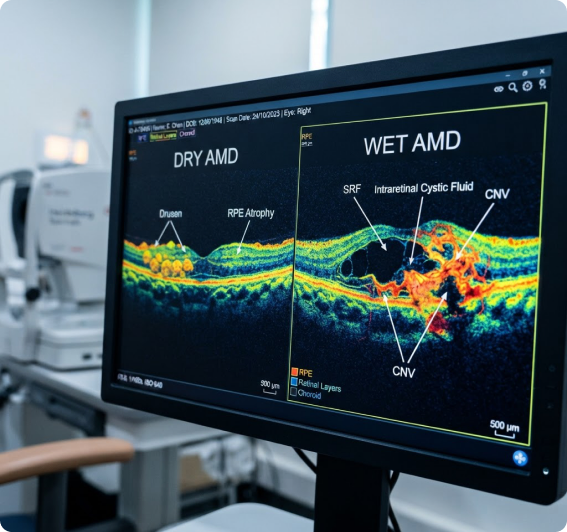
The most common form, affecting about 80% of AMD patients. It progresses gradually as drusen (protein deposits) accumulate under the retina. Dry AMD can advance slowly over years. It may progress to geographic atrophy (advanced dry AMD) which causes significant central vision loss.
Wet AMD
Less common but more aggressive. Abnormal blood vessels grow under the retina and leak fluid or blood. Wet AMD can cause rapid, severe vision loss and requires urgent referral to a retinal specialist for injection therapy. Fast diagnosis is essential.
Diagnostic Technology
Advanced Detection
With Precision Imaging
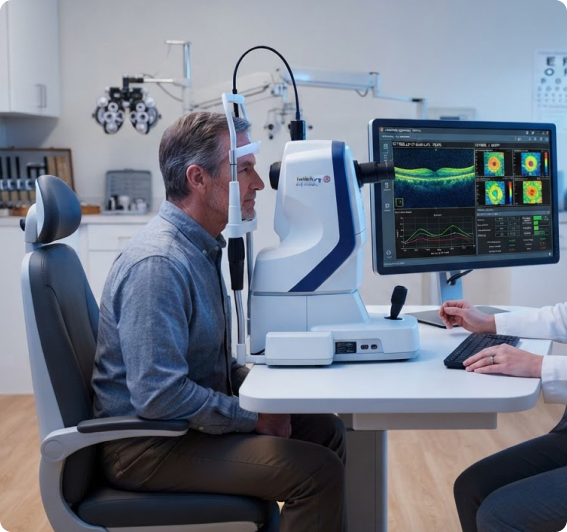
Optomap wide-field imaging and OCT scans give us a detailed view of your retina’s structure and let us compare it year to year. Changes that are invisible to the naked eye become visible in these scans.
Identifying changes early means we can start managing the condition before it significantly affects your daily life. We photograph your retina at every visit and track changes over time - this longitudinal data is invaluable for catching AMD in its earliest, most treatable stages.
- Optomap ultra-widefield retinal imaging
- OCT (Optical Coherence Tomography) scans
- Year-over-year retinal comparison
- “No-drop” dilationless technology available
Risk Factors
Who Is at Higher Risk?
Knowing your risk factors helps us prioritize screening frequency and tailor your
monitoring plan.
Age 50+
Risk increases significantly after age 50 and continues rising with each decade.
Family History
Having a parent or sibling with AMD significantly increases your likelihood of developing it.
Smoking
Smokers are 2-5x more likely to develop AMD than non-smokers.
Cardiovascular Disease
Heart disease and high blood pressure are associated with increased AMD risk.
UV Exposure
Prolonged sun exposure without UV protection may accelerate macular damage.
Diet & Nutrition
Low levels of lutein, zeaxanthin and omega-3s are linked to higher AMD risk.
Our Featured Treatments
AMD Treatment Options
We tailor your AMD treatment plan to your specific diagnosis, stage, and lifestyle. Here are the
primary options we offer at Eyes on 45th.
Valeda Red Light Therapy
The first FDA-authorized photobiomodulation treatment for early and intermediate dry AMD. Delivered in 9 sessions over 3-5 weeks, each under 5 minutes per eye. Only available in Fargo at Eyes on 45th.
- FDA-authorized for dry AMD
- Non-invasive and painless
- Exclusive to Eyes on 45th in Fargo
AREDS2 Supplement Protocol
The AREDS2 formula - containing lutein, zeaxanthin, vitamin C, vitamin E, and zinc - has been shown to reduce the risk of AMD progressing to advanced stages by 25%. We stock recommended supplements in our retail center.
- Clinically proven to slow progression
- Available in our in-office retail center
- Doctor-recommended formulations
Frequently Asked Questions
What is the difference between dry and wet AMD?
Dry AMD involves gradual changes in the macula, while wet AMD occurs when abnormal blood vessels leak beneath the retina and can cause faster vision loss. Sudden changes in central vision need prompt evaluation.
What is Valeda Red Light Therapy and how does it help AMD?
Valeda is a light-based treatment authorized for certain people with early or intermediate dry AMD. It may help some patients, but results vary and it is not a cure or a guarantee against vision loss.
Am I a candidate for Valeda therapy?
Eligibility depends on your AMD stage, retinal imaging, and overall eye health. An eye-care clinician can assess whether Valeda or another approach is appropriate for you.
How often should I be screened for macular degeneration?
The right schedule depends on your age, risk factors, symptoms, and exam findings. Your eye-care clinician can recommend follow-up timing; seek care promptly for new distortion or central vision changes.
Can AMD be reversed or cured?
AMD damage generally cannot be reversed, and there is no universal cure. Monitoring and treatments for some stages can help manage the condition and reduce certain risks of progression.
What AREDS2 supplements do you recommend?
AREDS2 supplements may benefit some people with intermediate AMD or advanced AMD in one eye, but are not appropriate for everyone and do not prevent AMD. Check with your clinician before starting supplements, especially if you take medicines or have other health conditions.
Request an Appointment
Share your preferred date and time, along with your contact information.
Online requests are not available yet. Information entered here is not sent or saved. Please call to schedule your appointment.
Send RequestReady when you are
Request an Appointment
To arrange an appointment, call us at (701) 492-3937. Our team will help find a time that works for you.
Office Hours:
 Office Hours:
- Monday - Thursday9:00 AM - 5:00 PM
- Dr. Tufte8:00 AM - 5:00 PM
- Dr. Rene9:00 AM - 5:00 PM
- Friday9:00 AM - 2:00 PM
- Saturday & SundayClosed